
Real-Time AI. Intelligence at the Speed of Your Data.
- Sub-100ms inference latency.
- 93% fewer false positives.

- Full lineage from raw event to model prediction.
Run ML models on every record as it arrives. Feature engineering, inference, and automated action. Sub-10ms latency. No batch scoring. No stale predictions.
What is real-time AI on Ververica?
Real-time AI on Ververica runs machine learning models directly inside Apache Flink stream processing pipelines. It covers feature engineering, model inference, A/B testing and automated actions on live data instead of stale batch predictions, and it can also call external model servers over REST or gRPC.
Key Statistics
- <100ms
- Inference LatencyEnd-to-end from event to prediction
- Now
- Feature EngineeringSub-second freshness, zero training-serving skew
- Full
- Governed LineageFrom raw event to model prediction
- 93%
- Fewer False PositivesFresh context vs. batch scoring
Core Capabilities
Real-Time Feature Engineering
Compute features from streaming data as events happen. Sub-second freshness.
Continuous Model Inference
Deploy ML models directly in streaming pipelines. Hot model reloading.
Streaming RAG Pipelines
Retrieval-Augmented Generation on real-time data. No periodic batch re-indexing.
Governed AI
Full lineage from raw data to model prediction. EU AI Act compliance-ready.
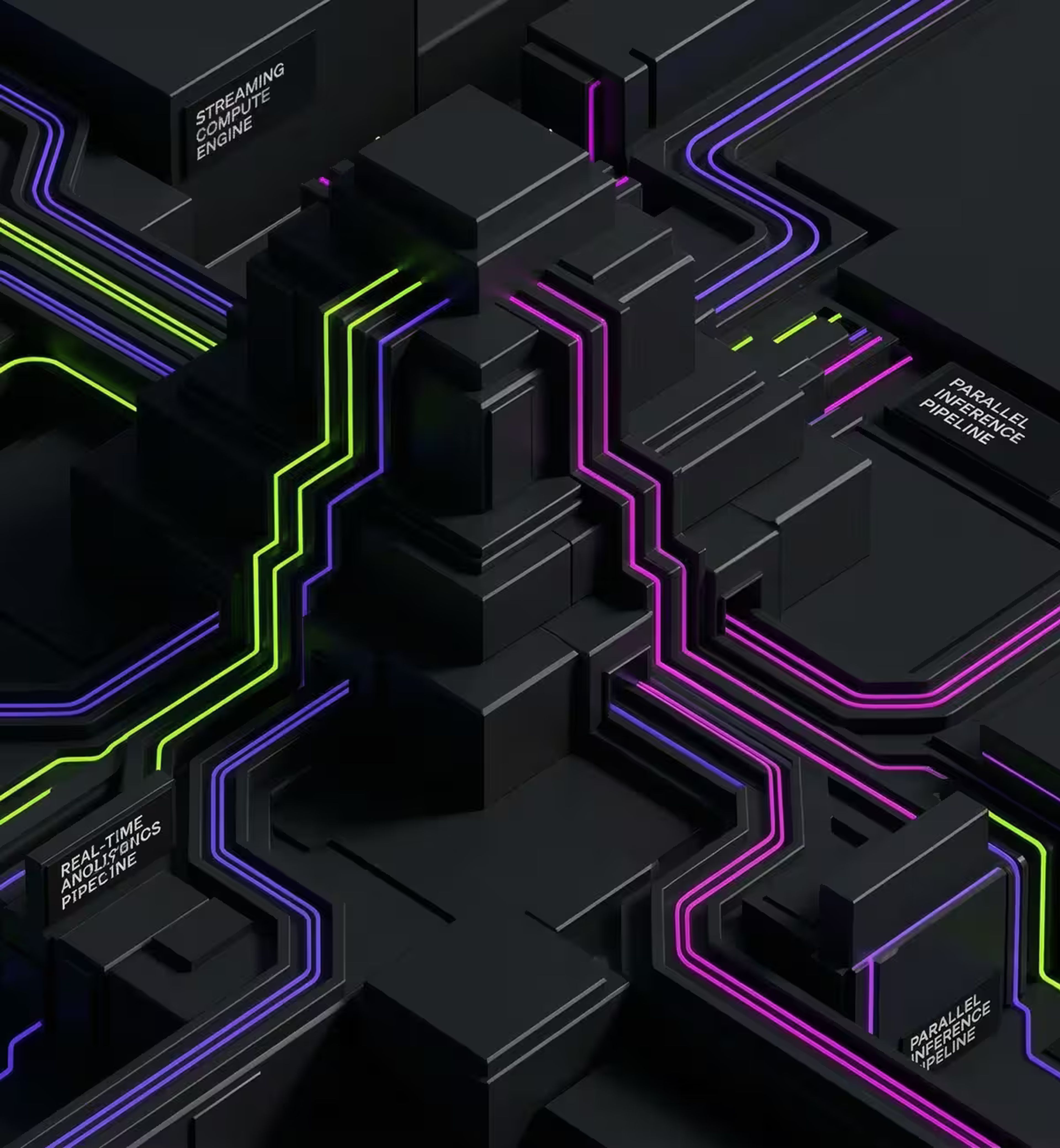

How It Works
No batch windows.
No scheduling.
No waiting.

Stream Features
Raw events arrive from sources. The VERA engine computes features in real time: aggregations, joins, transformations, derived metrics. Feature values update with every new event.
Score Models
Computed features feed directly into embedded models or external model servers. Every record receives a prediction. Fraud score, recommendation rank, anomaly probability, price adjustment. Inference runs at stream speed.
Act on Predictions
Predictions trigger actions immediately. Block a transaction. Adjust a price. Send an alert. Update a dashboard. Route to a human reviewer. The action happens milliseconds after the prediction, not hours.
Use Cases
Fraud Scoring
Score every transaction in real time. Compute risk features from transaction history, account behavior, and device signals. Run fraud models inline. Block suspicious transactions in under 50 milliseconds. Banks process millions of transactions per second on this pattern.
Dynamic Pricing
Adjust prices based on demand signals, inventory levels, and competitor data. Compute pricing features from streaming market data. Run pricing models on every relevant event. Push price updates to storefronts in real time.
Predictive Maintenance
Process IoT sensor streams from manufacturing equipment. Compute degradation features from vibration, temperature, and pressure data. Score predictive models on every reading. Trigger maintenance alerts before equipment fails.
Real-Time Recommendations
Personalize content, products, and offers as customers interact. Compute behavioral features from clickstream data. Score recommendation models on every page view. Deliver personalized results in the same request cycle.
Anomaly Detection
Identify unusual patterns across network traffic, financial transactions, or system metrics. Compute statistical features over sliding windows. Score anomaly models on every data point. Alert operations teams in seconds, not hours.
Intelligent Alerting
Replace static threshold alerts with ML-powered alerting. Models learn normal patterns and flag true anomalies. Reduce alert noise by 90%. Every alert that fires has a model-backed confidence score.
Frequently Asked Questions
01What is real-time AI on the Ververica Platform?
What is real-time AI on the Ververica Platform?
Real-time AI runs machine learning models inside streaming pipelines. The VERA engine computes features and executes model inference on every record at sub-10ms latency. Supported frameworks include TensorFlow, PyTorch, ONNX, scikit-learn, and XGBoost, plus external servers via REST and gRPC.
02How fast is real-time model inference?
How fast is real-time model inference?
Embedded models run with sub-10ms inference latency per record inside the streaming pipeline. External model servers add network round-trip time, typically 5-20ms depending on model size and infrastructure. Total end-to-end latency from event to action remains under 50ms for most production workloads.
03Can I use my existing trained models?
Can I use my existing trained models?
Yes. Export your model in TensorFlow SavedModel, ONNX, TorchScript, or pickle format and load it into the streaming pipeline. No retraining required. No model conversion. If your model runs in Python or Java, it runs in the Ververica streaming pipeline.
04How does real-time feature engineering work?
How does real-time feature engineering work?
The VERA engine computes features from streaming data as events arrive. Sliding window aggregations, cross-stream joins, running statistics, and derived calculations update with every new event. Features are always fresh, never stale batch computations.
05Does the platform support A/B testing for models?
Does the platform support A/B testing for models?
Yes. Route traffic between model versions in real time based on configurable split ratios. Track performance metrics on live data. The platform monitors prediction accuracy, latency, and business outcomes per model version to support data-driven model promotion decisions.

Make Your AI Real-Time.
Batch scoring is a report on the past. Real-time AI acts in the present. Run your models at stream speed. Every prediction delivered when it matters.