From Kappa to ξ: Streaming Architecture That Survives Production

Every streaming architecture looks clean on a whiteboard. That’s the easy part. Production actually grades whether it’s worth the hype.
For a decade the industry has argued Lambda against Kappa as if picking one settled anything. Lambda writes the logic twice. Kappa writes it once, then leaves you alone with everything that breaks the first time you replay a log inside a regulated bank.
Jaroslav Mojžíš has spent many years of his career in that gap, first as an architect inside large Czech banks, and later as the founder and CEO of our partner Resolve Base. He presented earlier this week at Stream Forward Prague his unique take to bridge that gap: ξ (Xi), an event-driven architecture running in production at two Czech financial institutions.
Lambda, Kappa, and the gap between them
Lambda was always a workaround for stream processors that could not yet be trusted with exactly-once, at-all-times correctness: a batch layer recomputing the truth overnight, a speed layer ‘guessing’ at it during the day, and a merge step nobody wants to own. Two code bases, two teams, two answers that drift apart. Apache Flink® raised the bar becoming mainstream in the late 2010s with exactly-once state, event time, and replay. Running the same logic twice in 2026 is not caution. It is technical debt on a nightly schedule.
Kappa fixed the core flaw. One pipeline, and history is a replay of the log. On paper it is elegant, but in production one often encounters four pitfalls:
- Raw data variability. Each consumer receives events in their source shape and rebuilds the same cleansing, joins, and translation for itself.
- Rebuilds. Replay counts yesterday's corrections a second time, and short retention has already forgotten part of the history.
- Consistency. Reference data arrives late, and records either vanish or appear twice.
- Reproducibility. A restart without state replays the log and sends every event downstream again.
Kappa says one pipeline. Production says one pipeline, many shapes, and a replay that has to be provably safe.
ξ: The next step forward for the agentic era
The name carries the design. The capital Ξ is three stacked bars: the layers. The lowercase ξ is one continuous stroke: the flow. Events stream through the layers and never rest in them.
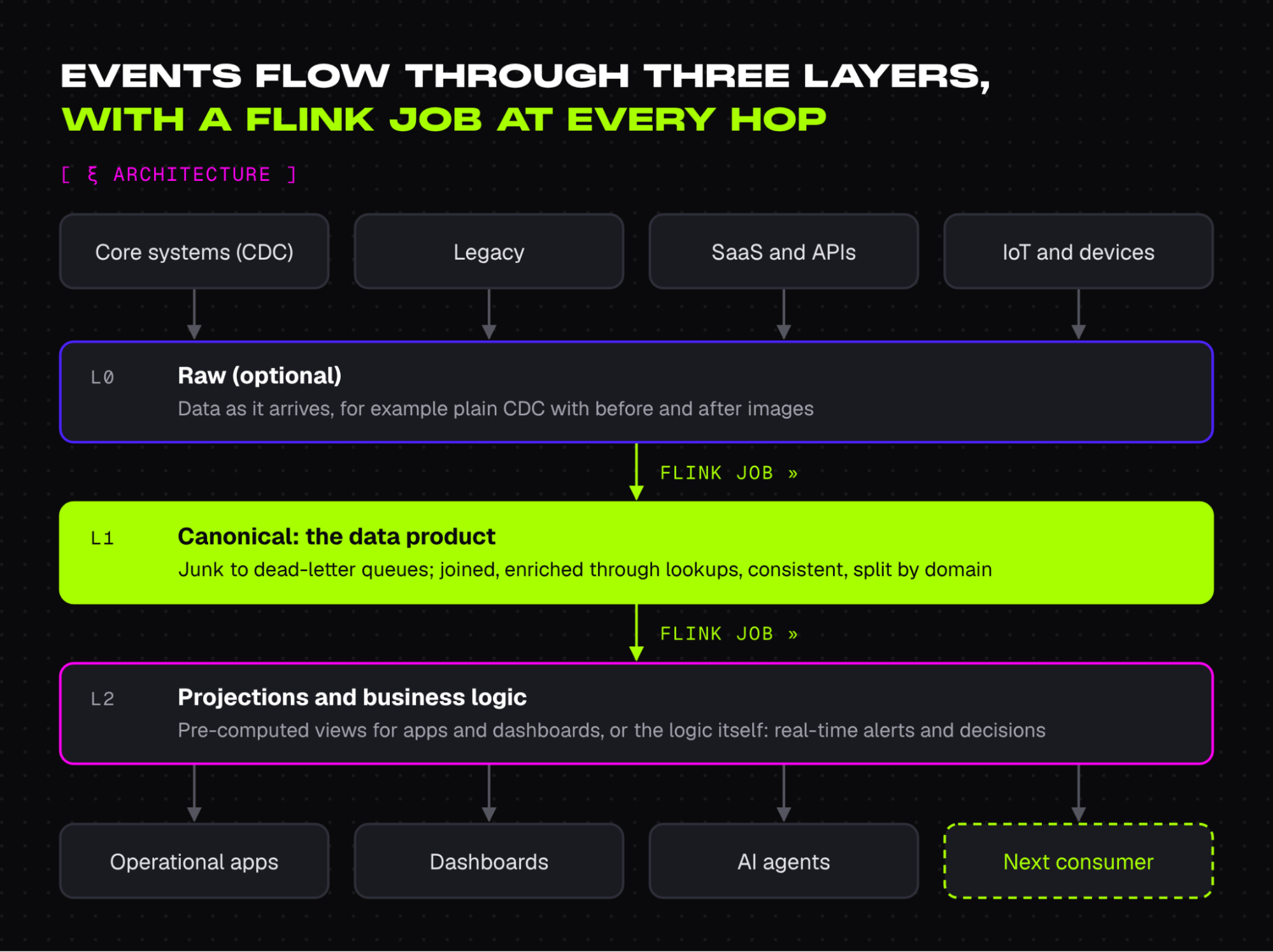
Apache Kafka keeps the log under every layer. A new consumer plugs into L1 or L2 and never touches the source.
- L0, raw (optional). Data as it arrives, such as plain CDC. Most streaming stops here, and so does most of what gets sold as data as a service.
- L1, canonical. The data product: junk sent to dead-letter queues, records joined, enriched, made consistent, and split by domain.
- L2, projections and logic. A view for each consumer, or the business logic itself: alerts and decisions in real time.
Every hop is a Flink job, and the fixes for Kappa live in those hops. Source snapshots anchor rebuilds. Left joins to "unknown" mean nothing gets dropped. IDs derived from the source event turn a replay into a no-op.
This is where Jaroslav breaks with integration orthodoxy. The old rule says business logic does not belong in integration. For real-time decisions he argues the opposite, because logic belongs where it can see the complete, current state, and understand the business meaning of the data – and that place is Flink. It is not the enterprise service bus in a new costume: each job is deployed independently with its own input, output, state, and owner, and can be scaled, changed, or switched off without touching the rest.
Medallion, in motion
When Jaroslav showed it to me, the first thing that came to mind was the analogy with the medallion pattern that has been popular in the lakehouse world for many years. ξ borrows its discipline layer for layer, but rebuilds it for state, event time, and replay.
| Role | Medallion (lakehouse) | ξ (streams) |
|---|---|---|
| Raw | Bronze: data as ingested, kept to reprocess from | L0: data as it arrives, optional |
| Trusted | Silver: cleaned, validated, deduplicated | L1: canonical, joined, enriched, split by domain |
| Consumed | Gold: models and aggregates for business users | L2: a projection per consumer, or the business logic itself |
| Recompute | Rerun the pipeline from Bronze | Replay the log, anchored on a source snapshot |
None of this discards medallion, but it rather carries its pattern into the real-time era. Medallion was designed for data that arrives in batches and pays off later, so its layers are tables: they rest, and a Gold table answers only when someone asks. ξ starts from the opposite assumption. Its layers are streams that events pass through, so an L2 job answers before anyone asks, at the moment the event happens. Recovery moves as well. The last layer changes, too. Gold ends where the analyst begins, but L2 ends where the business (or an agent!) takes action: an alert raised, a payment blocked, a command sent to a device. Medallion reports what happened. ξ acts on what is happening.
Medallion pipelines can ingest streams too. The difference is where the state and the decision live. In ξ, both live in Flink. It is the Streamhouse idea in practice: real-time and production-native, not batch with a streaming coat of paint.
Proof, not promises
Architecture claims are cheap, but Jaroslav would never stop at that. His Xi architecture is delivering in production in the Czech financial system.
At a regulated Czech investment firm, every change in the core system (orders, settlements, cash movements, corrections) updates client positions in Flink in real time. Dozens of Flink SQL jobs carry the complete business logic next to the core rather than inside it. Snapshot anchors, deterministic IDs, and automatic reconciliation keep positions correct, new logic runs in shadow pipelines first, and when a replay is needed Flink rebuilds the positions fast. That is the Kappa replay problem, solved in a system regulators audit.
At another Czech bank, Initially, integration relied on direct point-to-point connections, meaning that swapping out a single component required modifications across all connected systems. An architect’s nightmare. With ξ, the client, deal, and account data is published once into L1. Old and new systems consume the same data and run in parallel until the switch, and the legacy core becomes one more consumer whose L2 projection translates business keys into its own codes. Adding an application means plugging into L1. Removing one means unplugging it.
Your data is your identity
Jaroslav very neatly puts the stakes in five words: your data is your identity.
I made the same case from the platform side at Data Streaming Summit 2026 in San Francisco: in an AI era, the durable asset is the business data, and it loses value with every second it arrives late. A suspicious card payment or a stock-out is worth knowing while something can still be done. Late is the same as never.
When AI builds an application in hours, the application stops being the edge. Your clients, deals, and products, and how they relate, cannot be copied. The bottleneck has moved from building applications to feeding them, and most organizations still feed them through synchronous REST calls. Right for commands, REST fails as a data backbone: it ties consumers to provider uptime, chains outages together, and returns only the present, never what changed. It gives you the magnitude, but not the derivative.
Jaroslav's fix is a clever inversion: share data, not functions. Every change of state is written once to Kafka. Each application view becomes a projection that can be rebuilt, and new consumers plug in without touching the source. ξ makes that data trustworthy enough to build on in days, not months.
Streaming flows IRL
At Stream Forward Prague on November 18, the Resolve Base booth ran a bar on Flink. One tap on the tablet generates one event. Three Flink jobs enrich it, count it, and watch it. The dashboard updates in less than a second, and when the average ABV gets too strong, Flink switches a real MQTT smart plug in a second and a disco ball lights up. Event time, state, joins, windows, and real-time action, in a demo that makes people smile.
Resolve Base is Ververica's implementation partner in the Czech and Slovak republics. Jaroslav's team brings ξ. Ververica brings Delivery Assurance for mission-critical real-time data, built by the original creators of Apache Flink.
Critical won’t wait. Neither can you.
About the authors
Jaroslav Mojžíš is co-founder and CEO of Resolve Base, Ververica's implementation partner in Prague, and the architect behind ξ. Before Resolve Base he worked as an architect inside large organizations. Read his essay Your Data Is Your Identity. Contact: jaroslav.mojzis@resolvebase.com.
Jaime López is Director of Product Excellence at Ververica, the function that puts customers in direct contact with the people who built the engine.